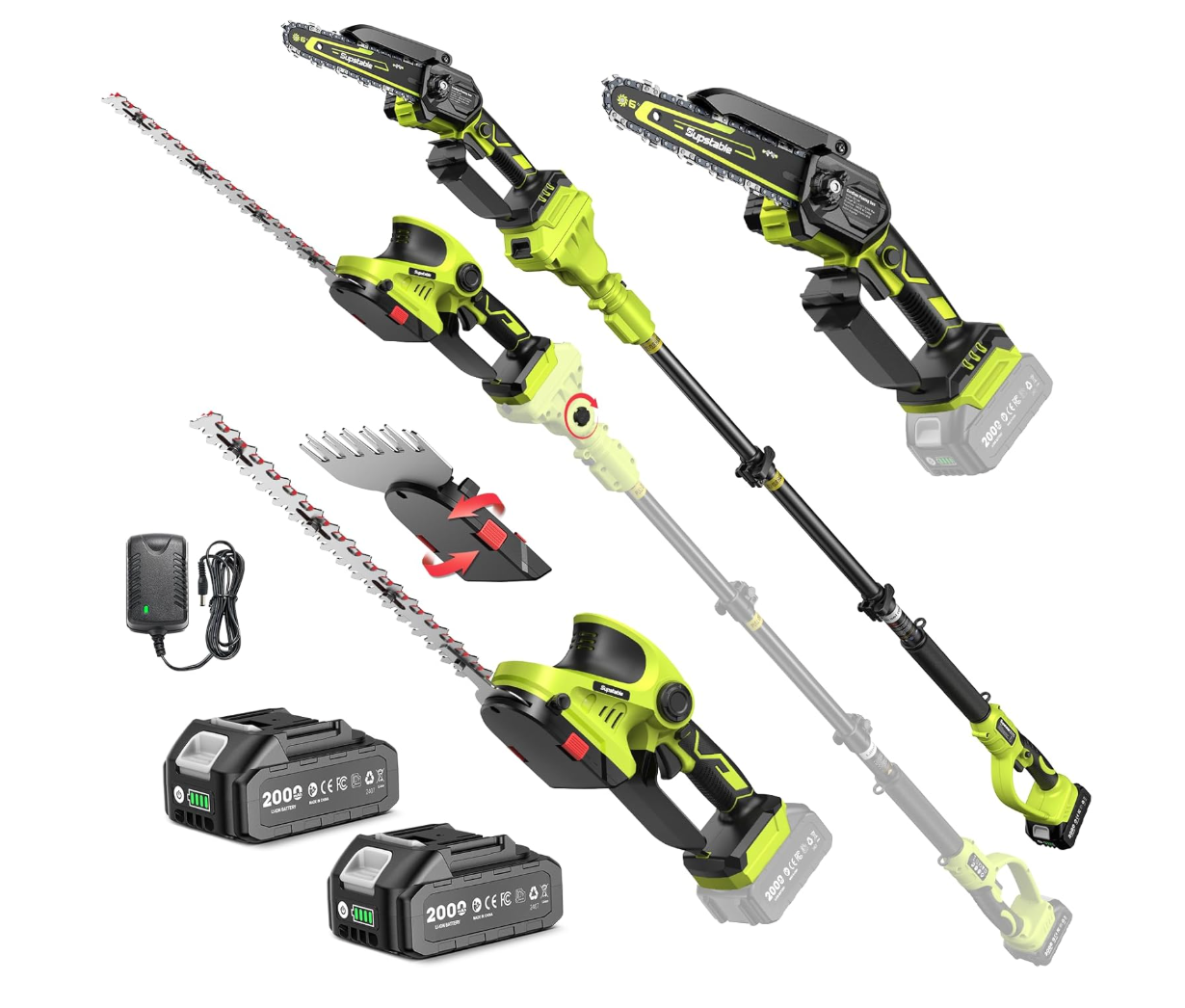
Supstable · Cordless 6-in-1
Pole Saw, Hedge Trimmer, Mini Chainsaw & More — One Tool, 15 ft Reach
If you're buying your first serious limb-cutting tool, this is the one I'd start with. The 6-in-1 design covers pole pruning, hedge trimming, and light chainsaw work — and the 15 ft extendable reach means you can tackle most overhead branches without touching a ladder. Cordless and surprisingly capable for a multi-tool.
- ✓ 15 ft reach with 180° multi-angle adjustable head (5 locking positions)
- ✓ 6 tools in one: pole saw, mini chainsaw, hedge trimmer, grass shears & more
- ✓ Brushless motor — 25.6 ft/s chain speed, cuts a 6-inch log in ~8 seconds
- ✓ Dual 21V 2.0Ah batteries included — fast charger in the box
- ✓ Shoulder strap included — designed for long sessions overhead
Affiliate link — price verified July 2026, may vary. We may earn a small commission at no extra cost to you.
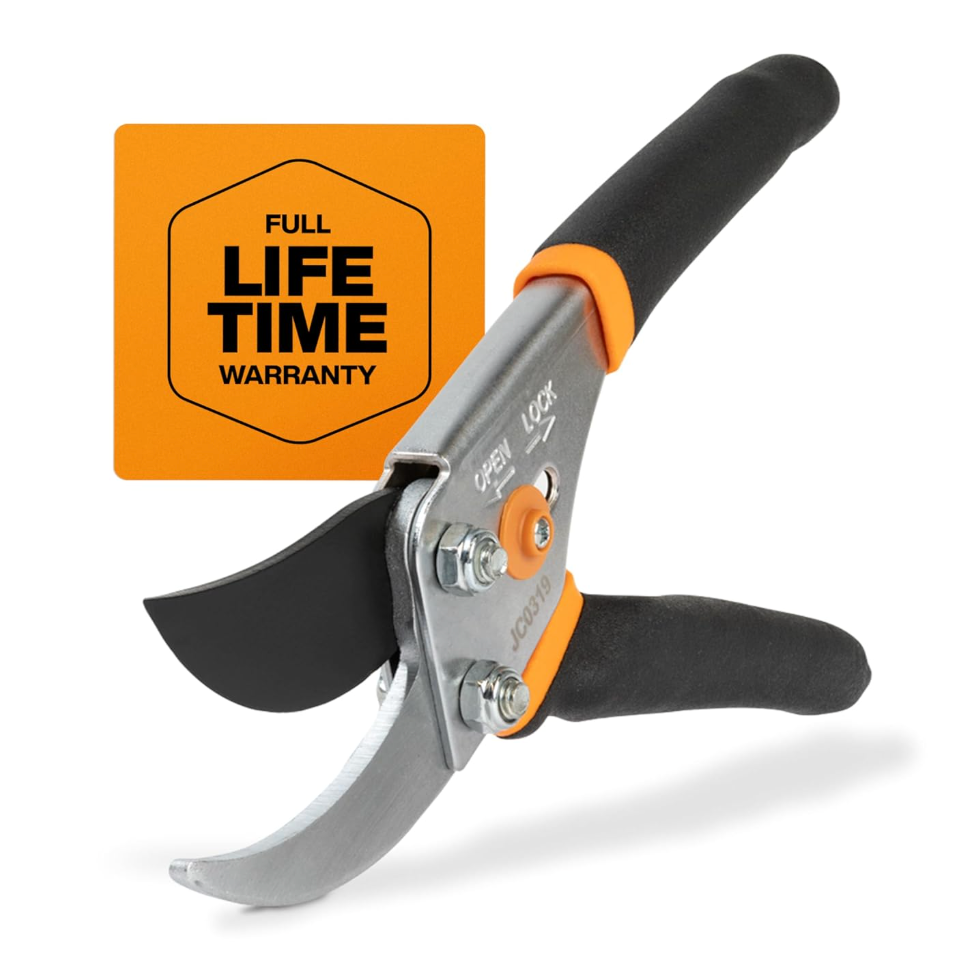
Fiskars · Bypass Pruner
Bypass Pruning Shears — 5/8" Cut Capacity, Self-Cleaning Blade, Lifetime Warranty
Every toolkit needs a reliable hand pruner, and Fiskars is the standard answer for good reason. The low-friction blade coating means sap doesn't build up and gum the blades shut mid-job, and the self-cleaning sap groove actually works. At $12.98 with a lifetime warranty, it's the easiest buy on this list.
- ✓ Cuts stems and branches up to 5/8" diameter cleanly
- ✓ Self-cleaning sap groove — blades stay smooth through the whole session
- ✓ Non-slip grip with ergonomic handle — designed for extended use
- ✓ Full lifetime warranty — Fiskars will replace or repair, no questions
Affiliate link — price verified July 2026, may vary. We may earn a small commission at no extra cost to you.
Seesii · 2-in-1 Cordless Pole Saw
10-Inch Pole Saw & Mini Chainsaw — 16 ft Reach, 900W Brushless, Dual 4000mAh Batteries
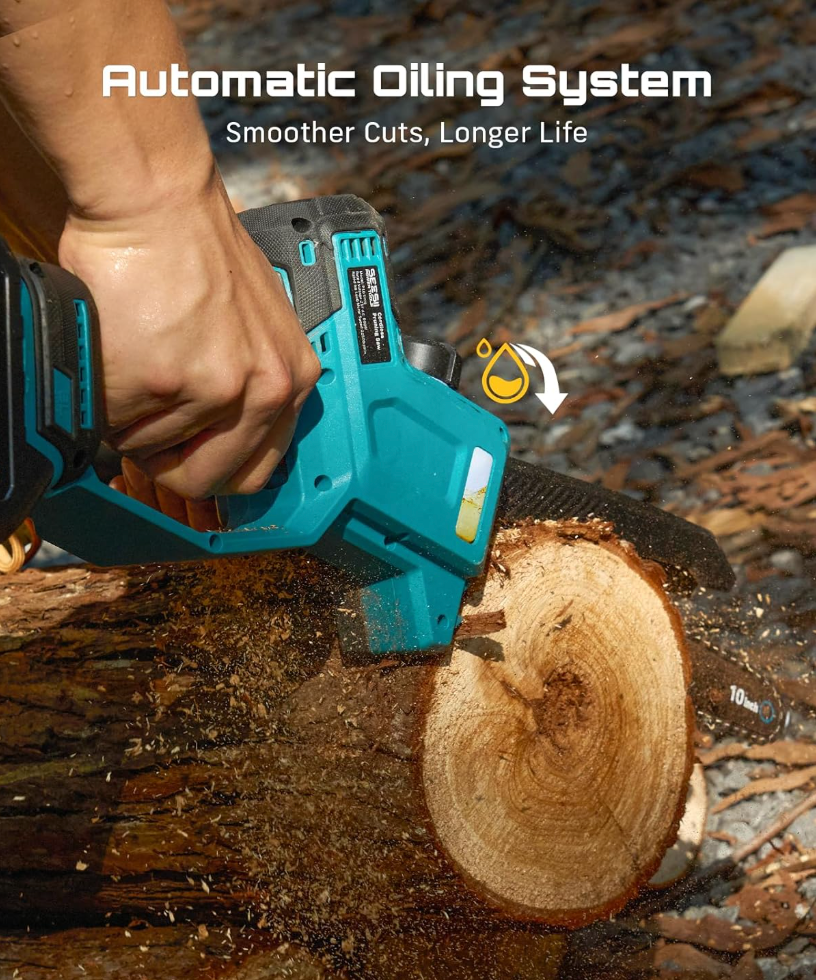
Where the Supstable does six different jobs at a lighter price point, the SEESII is built to go deeper on the chainsaw side. The 10-inch guide bar handles branches up to 8 inches thick — more than most cordless pole saws — and the 900W brushless motor with automatic oiling means it stays smooth across longer sessions. Detach the pole and it converts to a handheld mini chainsaw for close work. Two 4000mAh batteries included, fast charger in the box.
- ✓ 10-in guide bar cuts branches up to 8 in thick — more reach than most cordless pole saws
- ✓ Telescoping pole — total working reach up to 16 ft, no ladder needed
- ✓ 900W brushless motor — 26.2 ft/s chain speed, 30% more efficient than brushed
- ✓ Automatic oiling system — hands-free lubrication, reduces chain wear by up to 30%
- ✓ 2×21V 4000mAh batteries — 50–60 min runtime each; fast charger included
- ✓ Kit includes: extra chain, goggles, gloves, shoulder strap, bar cover, oil bottle
Affiliate link — price verified July 2026, may vary. We may earn a small commission at no extra cost to you.
Pick the Right Tool for the Job
Most homeowners only need two or three tools to handle everything they'll realistically encounter. The honest shortcut: if you're buying just one, start with a battery pole saw. It handles the most common situation — branches overhead that you can't safely reach — and keeps you off ladders. Everything else is supplementary.
Pole Saw
Best for: Branches 8–20 ft overhead, up to about 1.5 in thick
If you're only going to own one tree tool, make it a pole saw. It keeps you on the ground — which is the single most important thing for safe overhead limb work. Manual versions handle thin stuff fine; a battery-powered model (40V+) tackles branches up to 3 inches and is worth the extra cost if you have any real pruning to do.
Pros
- ✓Keeps you on the ground for most overhead work
- ✓Battery models handle branches up to 3 inches
- ✓Great for seasonal maintenance without a lot of setup
Cons
- ✗Manual versions tire you out fast on dense wood
- ✗Not the right tool once branches get over 3–4 inches
Battery Chainsaw (10–14 in bar)
Best for: Limbs 2–6 inches thick; occasional small tree felling
Modern battery chainsaws — especially 40V and 80V models — are serious tools now, not toys. For homeowner-scale limb work, a good cordless chainsaw will handle everything from thick branches to small trees, without the noise, fumes, and startup hassle of gas. Go 40V for lighter use; step up to 80V if you're cutting larger limbs regularly.
Pros
- ✓Handles most homeowner limb and small tree work easily
- ✓Battery models need almost no maintenance
- ✓Much quieter than gas — neighbors appreciate this
Cons
- ✗Requires proper safety gear (chaps, helmet, gloves — non-negotiable)
- ✗Not the right tool for large tree removal without experience
Hand Pruning Saw (Folding or Fixed)
Best for: Branches 1–4 inches where precision matters
For cuts right at the branch collar — the kind that actually lets the tree heal properly — a good hand saw beats power tools for control. Japanese-style pull saws cut on the pull stroke and glide through wood with surprisingly little effort. A folding version is safe to toss in a bag and carry around without thinking about it.
Pros
- ✓Best control for clean, close collar cuts
- ✓Zero setup, no battery, no noise
- ✓Cheap and easy to store — no excuse not to have one
Cons
- ✗Hard work on dense hardwood for more than a few cuts
- ✗Too slow for anything with real diameter
Bypass Loppers
Best for: Branches up to 1.5–2 inches, cleanup and maintenance
Loppers are what you reach for when you're cleaning up small branches, finishing a job, or doing routine shrub work. Look for compound-action or geared models — they cut the same branches with noticeably less hand strain, and it's worth the small price difference if you're spending an afternoon out there.
Pros
- ✓Clean bypass cuts that heal well
- ✓No power needed, easy to use in tight spots
- ✓Lightweight and quick to grab for small jobs
Cons
- ✗Limited to branches under roughly 2 inches
- ✗Redundant if you already have a good pole saw
Job Bigger Than You Expected? Here's What a Pro Costs
Once you're dealing with large trees, dead wood, or anything close to a structure or power line, a licensed arborist is the right call — not a braver tool choice. Use our free calculator to get a realistic budget before you reach out.
Takes 60 seconds · No signup required
Safety Rules Worth Actually Following
These aren't the kind of fine-print warnings you skip. They're the ones that show up in emergency rooms.
- Stand to the side, not underneath — even small branches are heavy and fall faster than you expect
- No chainsaws on ladders — ever — this is the combination responsible for a huge share of serious DIY tree injuries
- Check for power lines before you start, not after — stay at least 10 ft clear; call your utility for anything closer
- Wear real PPE — a hard hat, safety glasses, cut-resistant gloves, and chainsaw chaps if you're running a saw
- Have someone nearby — not watching from inside; actually outside with you for anything overhead
- Use the three-cut method on big limbs — undercut first (about 12 inches from the trunk), top cut to drop the weight, then the final clean cut at the collar
When DIY Becomes the Wrong Call
There's a clear line here, and it's worth knowing before you're halfway up a tree. DIY is reasonable when:
- Branches are under 4 inches in diameter
- You can reach them without going above about 15–20 ft
- There's nothing below that matters — open lawn, not a roof or fence
- No power lines anywhere near the fall zone
Outside those boundaries, you're not saving money — you're taking on risk that professionals have the training and insurance to manage. See our guide to signs a tree needs professional removal if you're trying to decide whether your situation has crossed that line.